What is this room for?
Whatever room you're treating, the calculator covers it.
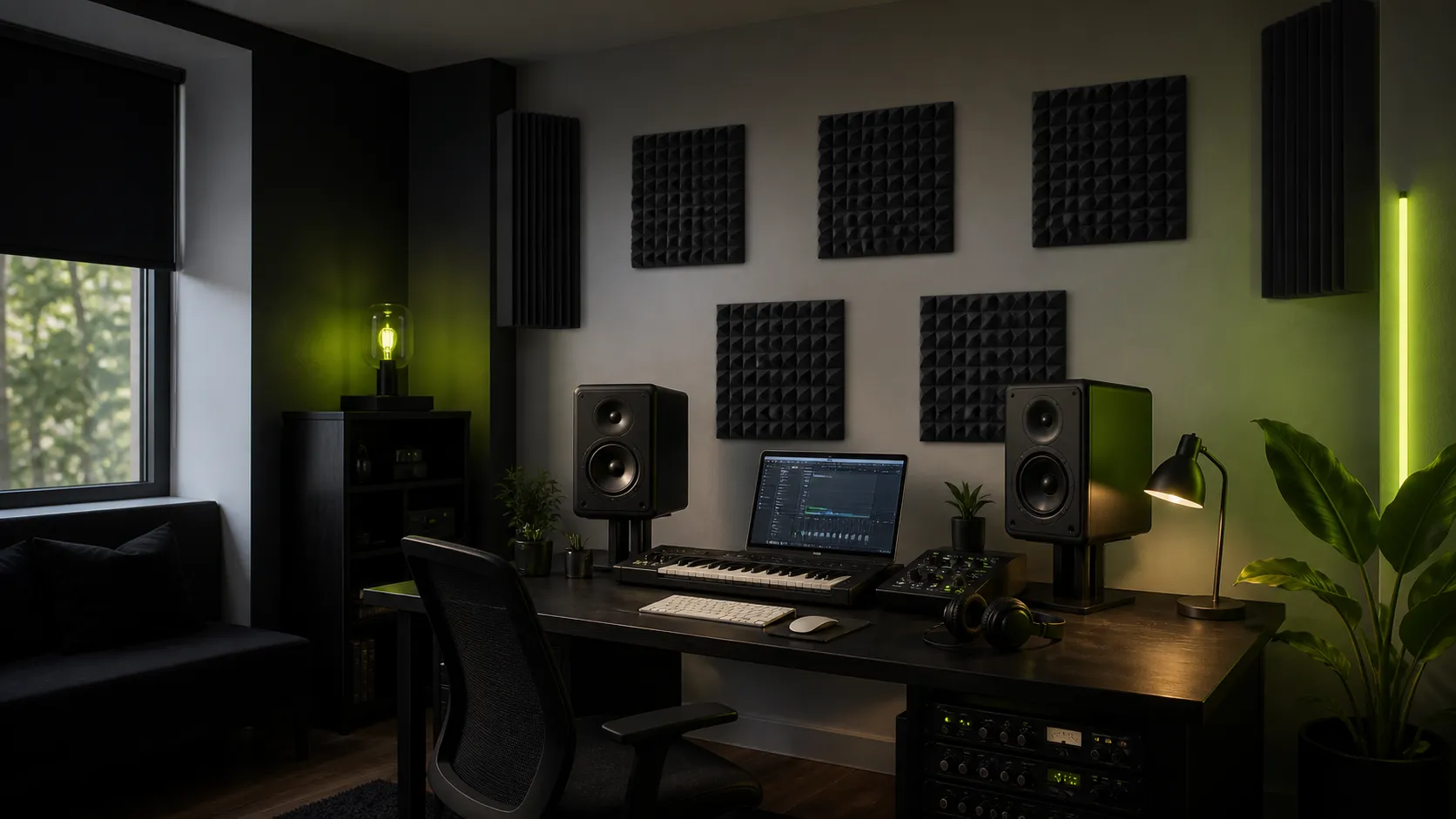
Home recording studio
Vocals tighter, mixes that translate. Carpet plus 2 absorption corners brings most small rooms to a usable studio. Bass traps next, when low end becomes the limit.
Podcast room
Voice forward, room out of the way. Two front absorbers plus a rug usually does it. Most podcast spaces don't need the full Estudio bundle.
Home office
Calls clearer, less fatigue at end of day. One absorber behind the laptop plus carpet handles most rooms. Add curtains if windows are large.
Living room cinema
Cleaner dialogue, music that fills the room without booming. Absorption on first reflections plus corner bass-trap covers most setups.
Properly treating a room is harder than it looks.
Buying a few foam panels and sticking them on the wall is what most people try. It almost never works. Treatment isn't about adding material; it's about adding the right material, in the right quantity, in the right places, for your specific room.
What "right" means in practice:
The right material
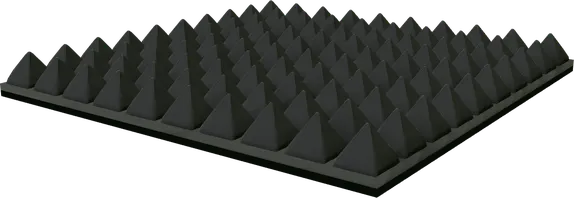
Foam density, thickness, absorption curve. Generic pyramid foam absorbs highs (where you didn't have a problem) and barely touches lows (where you did).
The right quantity
Under-treat and the room reads the same as before. Over-treat and you kill the highs, leaving a dead, weirdly-colored space. There's a window.
The right placement
First reflections from speakers and mics. Corners for bass. Ceiling for vertical bounces. Placement matters as much as quantity.
The right ratio of absorption to bass traps
Most rooms need both. Most DIY setups have neither in the right ratio: usually all-absorption, no bass-trap, with low-end problems untouched.
This is acoustic engineering. Pros use modeling software, calibrated mics, and a lot of room-specific judgment. Doing it yourself with Google and a credit card is a coin-flip: usually under-treated, sometimes over-treated, rarely right.
A treated room sounds different. Concretely.
- · Muddy, boomy bass that masks everything else.
- · Vocals sound "in a box."
- · Mixes don't translate: sounds great in the room, falls apart in headphones, car, phone.
- · Voice calls tiring; harder to follow at end of day.
- · "Why does my expensive mic sound this bad?"
- · Bass clear and defined; you hear individual notes, not a wash.
- · Vocals forward, present, intelligible.
- · Mixes translate to headphones, car, phone.
- · Calls clearer; less fatigue.
- · The mic finally does what you paid for.
The bridge. The materials aren't unique: anyone can buy acoustic foam. What's hard is the spec: the right quantity of the right material in the right places. That's what the calculator at the top automates. Tell it your room; it tells you the smallest bundle that lands you in target.
Three steps from room to recommendation.
We measure your room
Tell the calculator your dimensions and what's in it. The model uses Sabine acoustics with a modal correction for small rooms. The same math a studio designer uses, automated.
We propose a bundle
Three tiers: Iniciado (8 panels + 2 traps, €183), Estudio (16 + 4, €295), Pro (28 + 6, €443). The math picks the smallest tier that lands you in target. You upgrade only when you'd actually feel it.
You install it yourself
Adhesive mount. No drilling, no construction, no contractor. Most rooms take an evening.
Sabine, modal correction, NRC. The math behind your recommendation.
The calculator above is a Sabine-equation solver with a modal-correction term, built with Adrià Pastor, an acoustic engineer. [TBD: Pastor's one-line credential — studio designer / years experience / a name you'd recognize.]
What it does, beat by beat:
1. Reads your room. Length, width, height. Volume in m³. Surface area for the absorption math.
2. Reads what's already in it. Carpet, sofa, bookshelf, desk. Each has a known absorption profile that subtracts from the work the panels need to do.
3. Targets a reverberation time. Each use has a different RT60 target. Studio is tight (around 0.3 s). Podcast looser. Living room looser still. The targets are what a studio designer would specify for that use case.
4. Solves Sabine. Computes the absorption needed to land your room at target. Outputs the panel and bass-trap count required to get there.
5. Adds a modal correction. Rooms under 30 m³ are dominated by standing waves the Sabine equation underestimates. The calculator bumps the recommendation up a tier when you're in that zone.
6. Picks the smallest bundle that lands you in target. Iniciado, Estudio, or Pro. Not the biggest one we sell. The smallest one that gets you there.
The materials feed back into the math. The absorption panels we ship have measured NRC values [TBD: 0.29 per Pastor's Data v1, or 0.80 per Yuan Yuan supplier — Pastor sync open] that drive the per-panel absorption coefficient in the equation above. That's a measured number, not a marketing number on the box.
Two components. The calculator picks the ratio.
Absorption panel
€[X] each à la carte50 × 50 × 5 cm · NRC [TBD: 0.29 / 0.80] · high-density acoustic foam, warm-paper finish.
Handles mid and high frequencies: vocal clarity, instrument separation, dialogue. Tested to specification. Not foam-shaped wedges from a hardware-store rack.
Bass trap
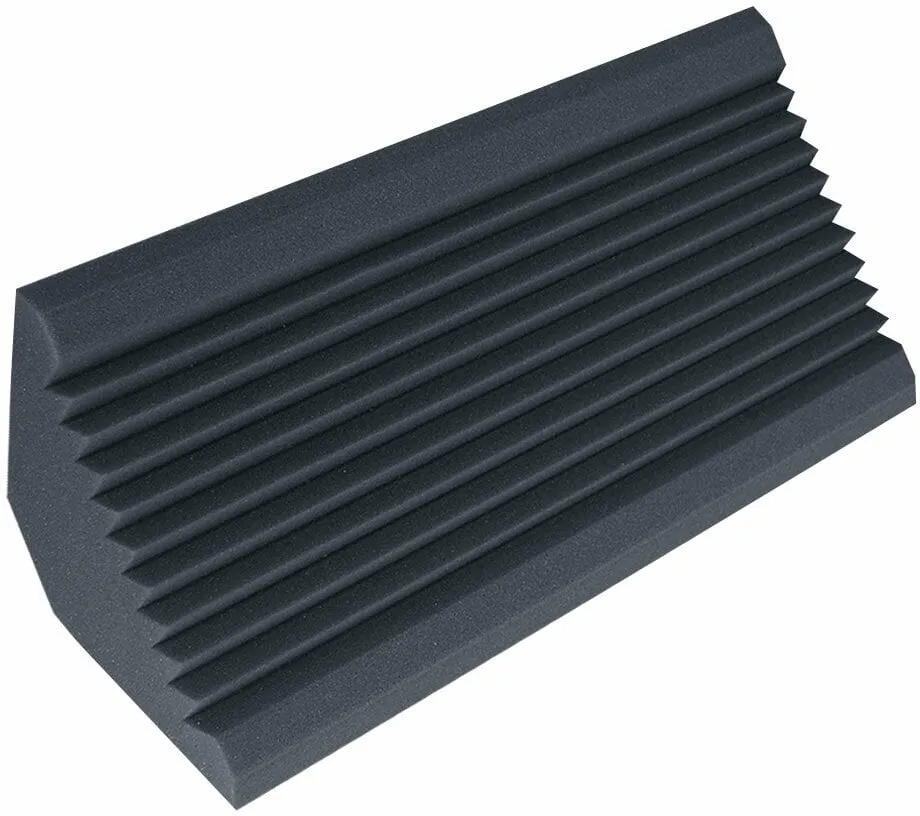
€[Y] each à la carte60 × 20 × 20 cm corner-mount wedge · gold-sand finish.
Handles low frequencies: boom, room modes, the muddy bottom-end that absorption panels can't reach. Mounts in vertical wall corners or horizontal wall-ceiling junctions. Same adhesive system as the panels.
The bundle is cheaper.
Most rooms need a balanced mix of absorption and bass-trap, and the calculator picks the right ratio (Iniciado 8+2 / Estudio 16+4 / Pro 28+6). Buying the calculator's recommendation as a bundle saves ~€[Z] vs the same components à la carte.
À la carte is for when you already know exactly what you need or want to add to an existing setup.
Why Eustik, and not the next foam off Amazon.
Real acoustics, not foam-shaped wedges
Standard pyramid foam from Amazon is decorative. Our panels are spec'd to NRC values that move the room. The calculator wouldn't work otherwise.
Tier system, not piece-by-piece guessing
You don't pick panels. You pick the bundle that matches your room. The math is done.
DIY install, contractor result
Adhesive-mount, no drilling, no studs. Same panels a small studio designer would spec. You mount them yourself in an evening.
Made in Spain, support in Spanish
Manufacturing and customer support both in Spain. 30-day returns, no questions.
The questions that come up.
Will this stop sound from leaving the room?
No. That's soundproofing: a construction job (decoupled walls, mass-loaded vinyl, sealed doors). What we do is acoustic treatment: making the sound INSIDE the room cleaner. Different problem, different solution. If your goal is "don't bother the neighbors," you need soundproofing, not us.
How do panels mount?
Adhesive backing. No drilling, no studs, no contractor. Removable cleanly with most paint finishes (we ship a tester strip; try one in a hidden spot first).
What if my room is bigger or smaller than the bundles?
The calculator picks the smallest bundle that lands you in the target range. If your room is bigger than Pro covers, you can buy multiple bundles or contact us directly. We'll spec it manually.
What's the difference between absorption panels and bass traps?
Absorption panels handle mid and high frequencies (vocal clarity, instrument separation, dialogue). Bass traps handle low frequencies (boom, room modes, the muddy bottom-end). Most rooms need both. The calculator's bundles are pre-balanced.
Returns?
30 days, no questions. Within Spain we cover return shipping; outside Spain you cover it.
Shipping?
Spain: 3-5 business days. EU: 7-10. Outside EU: contact for quote.
Run the calculator first.
The calculator at the top is the whole sales pipeline. Pick your use, type your dimensions, see what your room needs in three minutes.
[TBD: when the calculator has produced a recommendation, this block switches to State A — shows the recommended bundle inline with an Add-to-cart button. Requires lifting calculator state to a shared store. Implementation note in the wireframe.]